
From Paper Flyers to Data — How Asian Grocery Retail Has Changed in the Past 20 Years
Explore how Asian grocery retail has evolved from traditional paper flyers to data-driven insights, and what this shift means for shoppers and supermarkets today.

When I first entered the Asian grocery industry more than 20 years ago, many Chinese supermarkets in Canada were still relatively small operations.
Most of them had grown gradually from modest stores located near Chinatowns. Many of the owners knew each other or had some kind of connection through those early Chinatown grocery businesses.

Marketing at the time was simple.
Stores printed paper flyers and distributed them door-to-door in nearby neighbourhoods, or placed advertisements in Chinese and ethnic community newspapers. That was the primary way supermarkets attracted customers and built their business.
Flyers back then were literally stacks of printed paper.
After printing, they were distributed to households across the community.
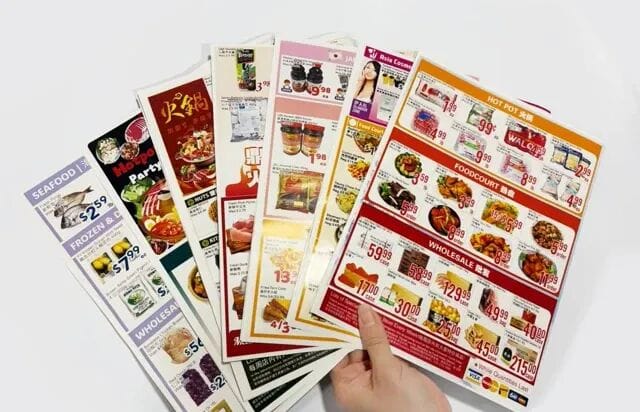
The key questions retailers cared about were very straightforward:
- How many flyers were printed?
- How many households received them?
- What was the population of the surrounding community?
- Which ethnic groups lived nearby?
In that era, the logic was simple:as long as the promotion reached people, it had a chance to bring customers into the store.

The Rapid Growth of Asian Supermarkets in North America
Over the past two decades, Asian supermarkets across North America have grown tremendously.
What started as small neighbourhood grocery stores near Chinatowns has evolved into large-format supermarkets — many occupying tens of thousands of square feet.

In the Greater Toronto Area alone today, there are well over 100 Chinese and Asian supermarkets.
The industry has long expanded beyond Chinatown districts into communities across the entire GTA — including cities like Markham, Richmond Hill, Scarborough, Mississauga and beyond.
At the same time, Asian grocery chains have expanded across Canada into cities such as:
- Vancouver
- Montreal
- Calgary
- Edmonton
Asian supermarkets are no longer serving only Chinese communities.They are increasingly popular among mainstream Canadian shoppers and many other ethnic communities as well.
As the industry has grown, the content inside flyers has also evolved — offering a wider variety of products and promotions than ever before.
Looking back, the past 20 years have been a remarkable period of growth and expansion for Asian grocery retail.

A New Challenge Emerging in Recent Years
However, in recent years I’ve begun to notice something new.
Many supermarkets appear to be entering a growth bottleneck.
Competition is becoming more intense.Operating costs continue to rise.Customers have more choices than ever.
But historically, these moments of pressure often signal the arrival of new opportunities.
In the coming years, the biggest difference between retailers may not simply be store size.
Instead, it may come down to who understands emerging trends — and who knows how to use new tools effectively.
My Work Has Always Revolved Around One Simple Thing: Flyers
Throughout my career, much of my work has revolved around something that seems deceptively simple:
the grocery flyer.
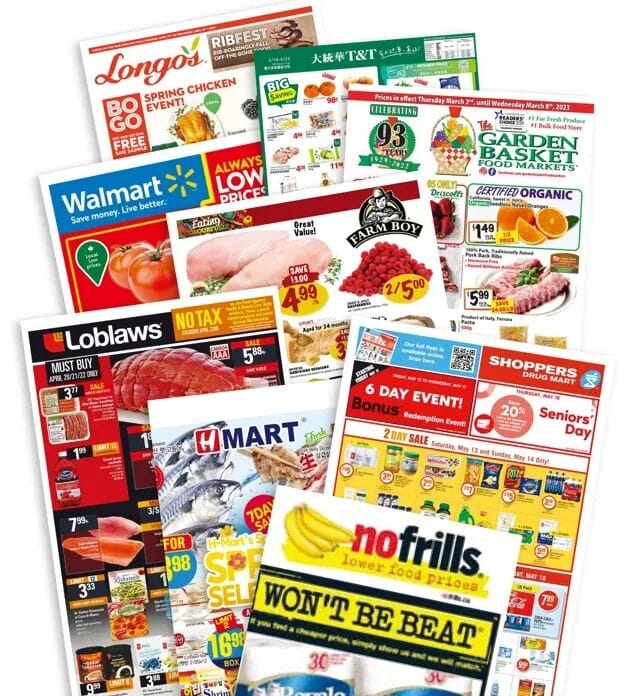
Over the years, flyers have gone through many transformations:
- Door-to-door paper distribution
- Ads in Chinese and ethnic newspapers
- WeChat public accounts
- Websites
- Mobile apps
- Social media platforms
And now, increasingly:
digital and data-driven flyers.
Despite all these changes, the core purpose of flyers has never really changed.
To bring customers into the supermarket.
For many years, flyers primarily solved one problem:
How to deliver promotional information to as many customers as possible.
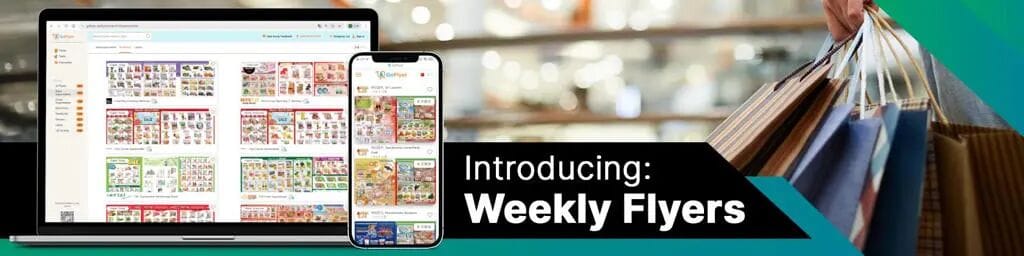
Retailers focused on metrics like:
- Number of flyers printed
- Newspaper circulation
- Distribution coverage
- How many neighbourhoods received the flyer
These were the key marketing indicators of that era.
A New Question Retailers Are Asking Today
But in recent years, a new question has started to emerge.
Most supermarkets still publish weekly flyers and feature many promotional deals.
Yet retailers are increasingly asking:
Which promotions actually attract customers?
And how effectively is this information reaching shoppers?
In many cases, there is no clear answer.
A typical flyer may contain dozens — sometimes over a hundred — promotional items.
Some are specialty products.Some are competitive price items.Others are high-volume promotions designed to drive traffic.
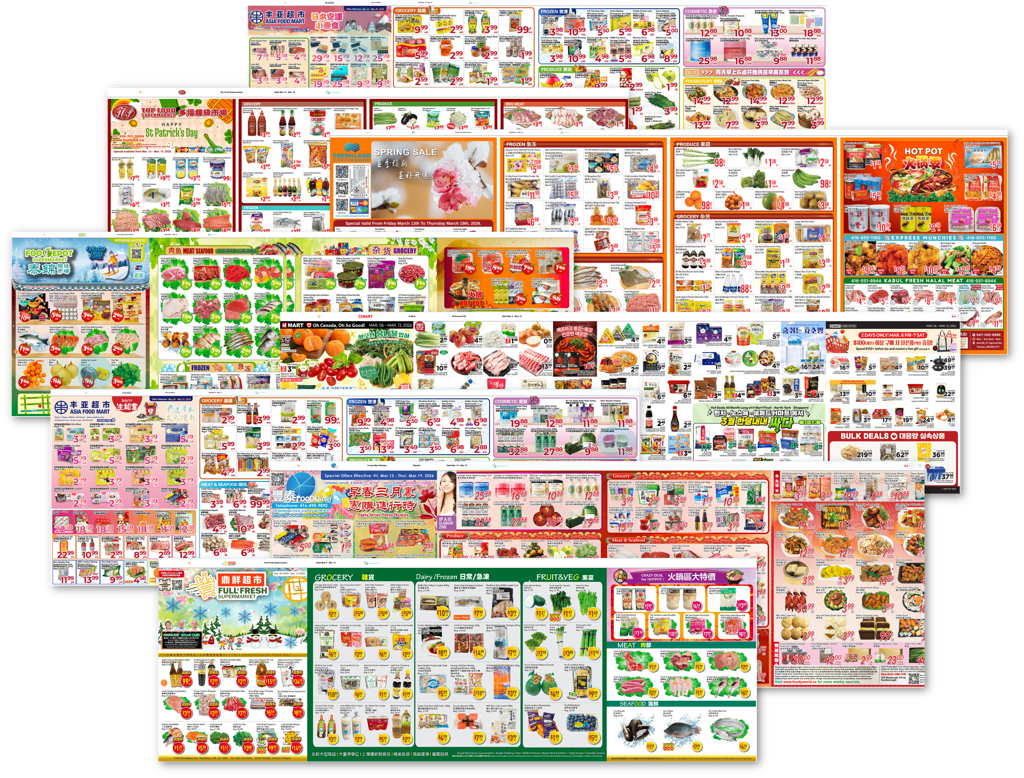
But traditional flyers — whether printed paper or PDF files online — share the same limitation:
They are static.
They can deliver information,but they rarely provide feedback.
In other words:
Traditional flyers solve the problem of information distribution.
But they struggle with information feedback.
When Flyers Start Generating Data
Over the past several years, things have started to change.
With the widespread adoption of smartphones, mobile apps, and digital platforms, flyers are beginning to evolve into something new.
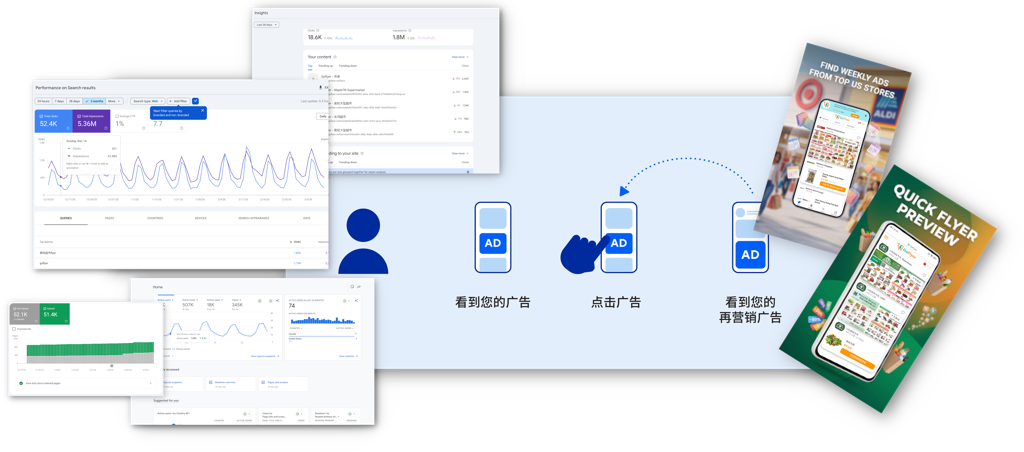
Flyers are becoming data-driven.
When each promotion is no longer just an image, but a digital item that can be:
- clicked
- viewed
- saved
- searched
- added to a shopping list
- tagged with data
then a flyer becomes more than an advertisement.
It becomes a structured set of data points.
Over time, this data can reveal insights that supermarkets previously couldn’t see, such as:
- Which products receive the most clicks
- Which items shoppers repeatedly view
- Which deals are most frequently added to shopping lists
- Historical price trends of specific products
- Which items appear repeatedly in promotions or seasonal events
- What products customers search for most often
- Which categories attract the most attention during certain periods
Many department managers may already have instincts about these patterns.
But are those observations accurate, measurable, and repeatable?
Without data, much of it remains based on experience or intuition.
Yet these insights represent some of the most valuable data assets a supermarket can have.
And as these datasets accumulate over time, they become an increasingly powerful decision-making tool.

Flyers as a New Business Intelligence Tool
In the future, flyers may undergo a fundamental transformation.
They will no longer be just a marketing tool.
They may gradually become:
a gateway to data and operational insights.
With access to real customer interaction data, supermarkets can better understand:
- what customers actually care about
- which promotions truly drive engagement
- how pricing strategies perform over time
- how to optimize product assortments
Of course, this transformation will not happen overnight.
Traditional methods will still play an important role:
- printed flyers
- social media promotion
- community outreach
But alongside these traditional approaches, a new trend is emerging:
moving from simply sending information out — to understanding what happens afterward.
From Distribution to Insight
In the past, marketing success was measured by inputs:
- printing costs
- advertising budgets
- distribution volume
But in the future, retailers may increasingly focus on outcomes:
- Did the flyer reach the right households?
- What products did customers actually view?
- Which deals captured attention?
- Which promotions truly generated interest?
These questions represent a fundamental shift in how grocery marketing may be evaluated.

Why This Moment Matters
At this stage in my career, I happen to be witnessing the rapid rise of AI, big data, and digital technologies.
Many things that once seemed difficult — or even impossible — are now becoming achievable.
That’s why I’ve decided to start sharing some of my observations from more than two decades working in the Asian grocery industry.
In this blog series, I will regularly write about:
- marketing trends in Chinese and ethnic supermarkets
- the evolution of grocery flyers
- digital transformation in the industry
- emerging opportunities for grocery retailers
My hope is that these insights can spark new ideas and discussions within the industry.
The Future of Flyers
For the past 20 years, flyers have been one of the most important marketing tools for Asian supermarkets.
And in the coming years, I believe one thing is certain:
Flyers will not disappear.
But they will evolve.
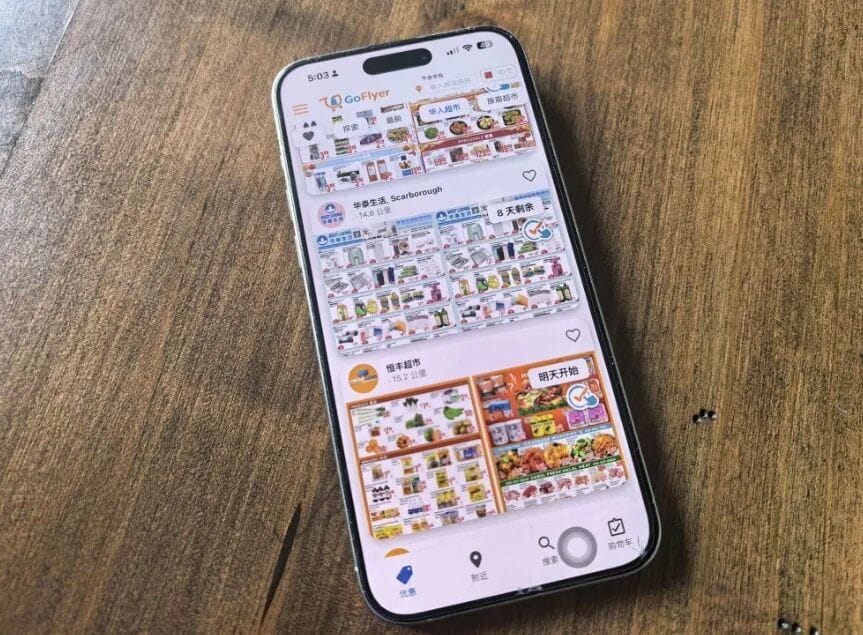
They may gradually transform from a simple promotional sheet into something much more powerful — a connection point between products, customers, and data.
When flyers begin to generate meaningful data, the way Asian supermarkets operate may enter a new phase.
In the near future, flyers may become one of the most important data entry points for ethnic grocery retail.
And in many ways,
this transformation is only just beginning.
Next in the Series
In the next article of “Steven on Supermarkets”, I will explore another question that many retailers face:
Why do many Chinese supermarkets run a large number of promotions —yet overall sales do not increase significantly?
There are actually several fascinating reasons behind this phenomenon.
