You Only See the Shoppers Who Already Chose You
Your reports show you who shopped at your store—but not who considered it and went somewhere else. Today, the decisions that shape weekend traffic are happening on customers’ phones, long before they reach the checkout.

They never appear in your reports — but they decide whose checkout line is busy on Saturday.
Understanding grocery retail through data. Discovering opportunities through insight.

Picture a Thursday night, around nine o'clock, in a kitchen in Markham.
A woman is cleaning up after dinner with her phone in her hand. She has already decided on hot pot for the weekend — beef, some vegetables, a few sauces.
She searches for sliced beef.
Three stores have it on special. One has the lowest price but is a twenty-minute drive. One is a little more expensive but on her way home. The third has ordinary beef, but the seafood in the photo looks good.
She compares for a minute, saves two items from the second store, and on Saturday she drives to the third.
That evening, she spent about four minutes deciding between your store and two others.
If she didn't end up at yours, those four minutes appear nowhere in your reporting.
Every number you have describes someone who already walked in
Most grocers today have more data than they did ten years ago. POS reports, daily sales, department margins, loyalty history, inventory turns, vendor numbers.
All of it is useful. But all of it shares one condition:
this person is already inside your store.
Your POS tells you what someone bought. It doesn't tell you what they came in for and couldn't find.
Your loyalty program tells you how often a regular shops with you. It doesn't tell you where they went the two times last month they didn't.
Your store managers have excellent instincts, but the faces they know well are the faces that keep showing up.
In other words, every report you read and every instinct you trust describes the same group of people: the ones who already decided to come.
The shoppers who were comparing, hesitating, and ultimately chose somewhere else are invisible to you. And that is exactly where the growth is.
The decision moved off the kitchen table
This used to be a smaller problem.
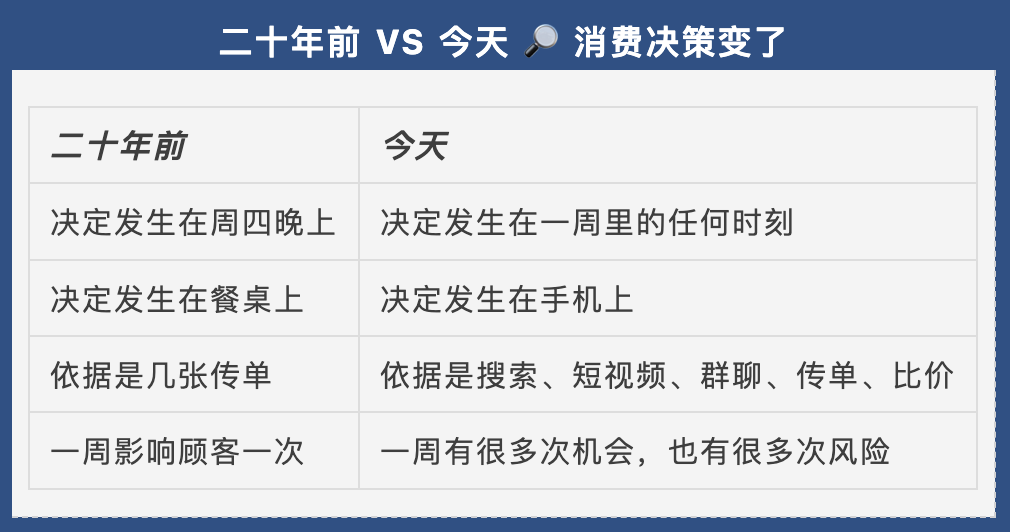
Twenty years ago, the decision happened at the kitchen table. Flyers arrived Thursday, got spread out side by side, and a family compared chicken, beef and produce in one sitting.
We couldn't watch that moment either — but we knew when it happened and what it was based on. It was those few pieces of paper. So printing well, pricing sharply and distributing accurately was, more or less, enough.
That's no longer true.
The decision has been broken into pieces and scattered across the week. It happens on a phone during the commute, in a group chat where someone asks who has ribs on sale, in a Google search for a store nearby, in bed at ten at night while flipping through three digital flyers.
It happens constantly, in places you have no access to. And every one of those moments quietly shapes whose parking lot fills up on Saturday.
The good news: those shoppers leave a trail
Before someone decides where to shop, they take real, observable actions.
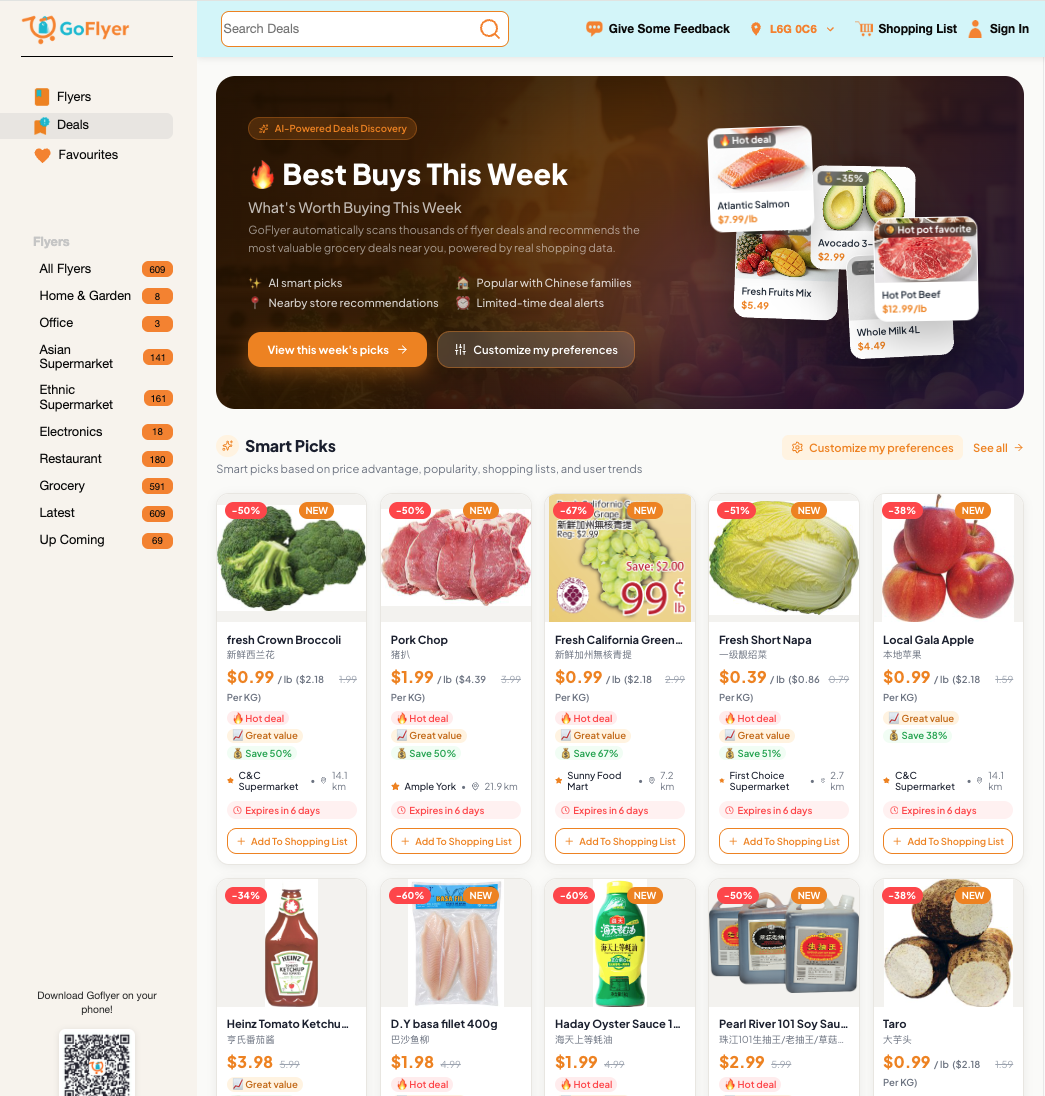
They search for a product. They look at prices across several stores. They save items and add them to a shopping list. They open a store page, or tap for directions.
It is worth being precise here, because these actions are not the same thing as likes and views.
Someone who likes a post may have tapped it while scrolling and forgotten it three seconds later.
Someone who deliberately adds your beef to their shopping list is planning their weekend.
Saves and shopping lists are the closest thing retail has to a shopper saying "I intend to buy this."
That has been one of the more useful lessons of building GoFlyer: the number that matters isn't how many people viewed a flyer. It's how many people did something afterward that only a buyer would do.
A shopper who is still comparing will only spend those extra two seconds on an item that genuinely moved them.
Three questions worth asking this week
1. Where does my price rank in this neighbourhood?
Most operators know their own price. Fewer know what the three or four stores around them are charging for the same item at the same moment. A price that feels aggressive internally may sit third on a shopper's list. That comparison is now visible — shoppers make it every day, and so can you.
2. Of the people who saw it, how many saved it?
This may be the most underused signal in grocery retail.
High visibility with very few saves usually isn't a promotion problem. It's a price or product problem. And it shows up before you print the flyer and before you commit to the volume.
3. What are shoppers searching for — and did I feature it?
Search is the most honest signal you can get, because the shopper typed it themselves. If your area spent the week looking for something that never made your front page, that's an opportunity you handed to someone else.
None of these require new systems or major investment. They belong in the weekly review you already run.
Which is why midweek promotion isn't "posting more often"
We've written before about Mini Flyers and Daily Specials, and the fair question from operators is: isn't this just running more ads?
If that's all it is, it isn't worth doing.
The value is in the timing.
A weekly flyer speaks to everyone at one fixed moment.
A Mini Flyer or Daily Special appears while the shopper is still deciding.
Good seafood lands Tuesday morning. Someone is thinking about Wednesday's dinner on Tuesday night. The temperature drops Thursday and half the neighbourhood starts thinking about hot pot.
Each of those is a decision forming in real time. A weekly flyer can't reach them. Today's tools can.
Choose a dozen products worth featuring that day, build it in a few minutes, publish it to your own website, push it through social, and put it in front of shoppers who are actively looking for grocery deals right now.
That isn't running another ad. That's being in the consideration set before the decision is made.
The shift
Twenty years ago we competed on how many flyers we printed and how precisely we distributed them. The decision sat on a kitchen table, and several stores were compared side by side on paper.
Today that decision has moved onto a screen we can't see, and it happens several times a week.
We can't move it back to the kitchen table. What we can do is be on that screen during the few minutes it's happening.
The customers you can see have already chosen you.
The growth is in the ones you can't.
Coming next
In the next piece, we'll get concrete: a single case of salmon that arrived on a Tuesday morning, and everything that happened to it over seven days.
When was the decision made to feature it? How was the content produced? Where did it go? When did the numbers come back? And what changed for the next delivery?
One product, the whole chain.
GoFlyer connects Canadian shoppers with local retailers through digital flyers, retail data, and market insights — helping shoppers find better deals and helping retailers turn every promotion into real sales.
Part of the GoFlyer Grocery Insights series. © GoFlyer Inc. All rights reserved.
—Previous Posts—
 Steven Guan
 Steven Guan